CircleUp® Workplace Compliance Training

Sexual Harassment Prevention Training for Employees, Supervisors & Managers

OverStep™ is practical sexual harassment prevention training built around workplace boundaries, power dynamics, realistic scenarios, reporting, prevention, and what people can actually do when concerning conduct occurs. Choose a 1-hour employee course or a 2-hour supervisor and manager course, with self-paced, SCORM/LMS, live online, and onsite options.

1-Hour Employee Edition 2-Hour Supervisor Edition SCORM / LMS Available Live Online + Onsite Certificate of Completion
$29.99 self-paced pre-order pricing
01 / SELF-PACED

Take OverStep™ online

Choose the employee or supervisor edition, learn on your schedule, complete the required course activities, and receive completion documentation.

Compare self-paced editions
02 / ORGANIZATIONS

Deploy it your way

Bring OverStep™ onsite, live online, through bulk seats, or inside your own learning management system with a SCORM package.

Explore training formats
03 / FREE PREVIEW

Experience the training first

Join a free Workplace Compliance Preview to see selected activities, course framing, implementation options, and live Q&A with CircleUp®.

View upcoming previews

Why OverStep™

Most harassment training starts with the law. OverStep™ starts with the moment a boundary gets crossed.

OverStep™ gives learners a practical framework for recognizing what is happening in real time: What boundary is here? What changed? What power is operating? What is the impact? What can I do next?

From there, the training connects everyday workplace judgment to sexual harassment, sex-based harassment, discrimination, retaliation, abusive conduct, protected characteristics, reporting options, prevention, and appropriate response.

Boundaries first Personal, professional, organizational, and legal boundaries give people a framework they can use.
Power made visible Learners examine how authority, bias, fear of retaliation, and workplace pressure affect decisions.
Real decisions Scenario-based learning moves beyond definitions into recognition, analysis, and response.
Practical next steps Employees and supervisors learn options for interrupting, reporting, supporting, and following up.
OverStep workplace harassment training scenario activity with multiple workplace situations
Scenario-based learning built for real workplace decisions

Built for workplace learning

Required training can still be thoughtful, practical, and memorable.

OverStep™ was designed for adults across industries, with visual scenarios, reflection, knowledge checks, practical decision points, and multiple ways for organizations to deploy the training.

2 editions Role-specific paths for employees and supervisors/managers.
15 industries Testing included participants and reviewers across a wide range of workplaces.
SCORM Available for organizations that want OverStep™ inside their existing LMS.
Annual review Course content is reviewed to keep terminology, examples, and legal references current.

Self-paced OverStep™ courses

Choose the training that matches the learner's role.

Individual self-paced enrollment is available for pre-order. Product cards below link directly to CircleUp.shop. Prices are intentionally not displayed on these cards so Shopify remains the source of truth at checkout.

OverStep Sexual Harassment Prevention Training Employee Edition 1-Hour Employee Edition

OverStep™ Sexual Harassment Prevention Training: Employee Edition

For nonsupervisory employees. The course focuses on boundaries, recognition, sexual and sex-based harassment, discrimination, retaliation, reporting, bystander choices, prevention, and response.

  • Approximately 1 hour of self-paced learning
  • Interactive scenarios and knowledge checks
  • Certificate of completion
  • Built for employee harassment-prevention requirements and multi-state deployment

Pre-Order Employee Course
OverStep Sexual Harassment Prevention Training Supervisor and Manager Edition 2-Hour Supervisor + Manager Edition

OverStep™ Sexual Harassment Prevention Training: Supervisor & Manager Edition

Includes the employee foundation plus supervisor-specific responsibilities involving power, receiving concerns, reporting and escalation, anti-retaliation, intervention, expectations, and follow-up.

  • Approximately 2 hours of self-paced learning
  • Supervisor-specific scenarios and decision points
  • Certificate of completion
  • Designed for managers and supervisors with additional prevention and response responsibilities
Pre-Order Supervisor Course

Learning outcomes

Clear outcomes for employees and supervisors.

The learning outcomes below are reproduced from the OverStep™ training presentation so buyers can see exactly what each course is designed to accomplish.

1-Hour Employee Edition Learning Outcomes

By the end of this course, you will be able to:

  1. Identify and distinguish forms of workplace sexual harassment and prohibited conduct, including quid pro quo and hostile work environment harassment, sex-based discrimination, retaliation, and abusive conduct.
  2. Analyze the impact of overstepped boundaries in the workplace, including sexual harassment, and the challenges and barriers that can affect a person’s ability to interrupt, respond to, or address concerning conduct.
  3. Identify rights, protections, and reporting options available to employees who experience sexual harassment and inappropriate workplace conduct, including internal and external reporting pathways and available remedies.
  4. Apply strategies to prevent, respond to, and interrupt sexual harassment and inappropriate workplace conduct, including communicating and respecting boundaries, responding to concerning behavior, using appropriate bystander intervention strategies, and seeking support to report concerns.

2-Hour Supervisor & Manager Edition Learning Outcomes

By the end of this course, you will be able to:

  1. Identify and distinguish forms of workplace sexual harassment and prohibited conduct, including quid pro quo and hostile work environment harassment, sex-based discrimination, retaliation, and abusive conduct.
  2. Analyze the impact of overstepped boundaries in the workplace, including sexual harassment, and the challenges and barriers that can affect a person’s ability to interrupt, respond to, or address concerning conduct.
  3. Identify rights, protections, and reporting options available to employees who experience sexual harassment and inappropriate workplace conduct, including internal and external reporting pathways and available remedies.
  4. Apply strategies to prevent, respond to, and interrupt sexual harassment and inappropriate workplace conduct, including communicating and respecting boundaries, responding to concerning behavior, using appropriate bystander intervention strategies, and seeking support to report concerns.
  5. Analyze how power dynamics and supervisory authority can influence workplace interactions and sexual harassment, including how power can contribute to inappropriate conduct, affect an employee’s ability or willingness to speak up, and be used to prevent or address harmful behavior.
  6. Apply appropriate procedures when receiving a complaint or becoming aware of sexual harassment, including responding to employees, reporting concerns, understanding the limits of confidentiality, recognizing and preventing retaliation, and supporting appropriate follow-up.
  7. Apply supervisory specific strategies to prevent, interrupt, and address sexual harassment and other prohibited workplace conduct, including establishing clear expectations, communicating policies and reporting options, intervening when concerning behavior occurs, and selecting appropriate intervention strategies based on the situation, power dynamics, and potential impact.

Inside OverStep™

A practical path from boundaries to prevention, reporting, and response.

The course connects required harassment-prevention concepts to the situations employees and supervisors encounter in actual workplaces.

01Boundaries 101
02Workplace boundaries
03Recognizing an OverStep
04Discrimination, harassment & sexual harassment
05Where harassment can happen
06Power, bias & barriers to speaking up
07Reporting & anti-retaliation
08Prevention & response

Training formats

One course framework. Multiple ways to deliver it.

Choose the format that fits your organization, LMS, workforce size, location, and implementation plan.

24/7

Self-Paced Online

Individual learners can complete the appropriate OverStep™ edition online on their own schedule and receive completion documentation after satisfying course requirements.

WEB

Live Online

Facilitated virtual delivery for distributed teams, remote staff, multi-location organizations, and groups that want live discussion and guided learning without travel.

TEAM

Bulk Seats & Rollouts

Purchase seats for teams, departments, or larger workforces. CircleUp® can help map employee and supervisor assignments and discuss rollout logistics.

EDIT

Organizational Customization

Discuss custom introductions, employer policy and reporting information, internal contacts, selected examples, branding, and other scoped modifications that support your implementation.

Multi-jurisdiction deployment

Built for organizations that need more than a one-size-fits-all compliance claim.

OverStep™ is designed around content areas that appear across workplace harassment-prevention requirements, with role-specific employee and supervisor paths and room for jurisdiction-specific deployment decisions.

California

The 1-hour employee edition is designed around California's nonsupervisory training framework. Supervisors and managers use the 2-hour edition.

Chicago & Illinois

Chicago requires annual sexual harassment prevention training and also adds a separate annual bystander intervention requirement. Organizations should assign all required components.

Multi-State Workforces

CircleUp® can help organizations identify the appropriate OverStep™ edition by role and discuss local timing, policy, trainer, industry, or supplemental requirements that may apply.

Compliance requirements vary by jurisdiction, employer size, industry, role, timing, delivery method, and employer-specific obligations. OverStep™ should be deployed with the organization's current policy and applicable local requirements. CircleUp® can help map a training pathway, but organizations should confirm legal requirements applicable to their workforce.

Free live preview · Online

Upcoming Workplace Compliance Training Previews

Choose a date that works for you. Each FREE 90-minute sampler session previews a collection of CircleUp® Workplace Compliance Trainings, including OverStep™ Sexual Harassment Training, Gender Uncovered™, Disability Uncovered™, and selected cultural competency courses. Each session includes a 60-minute training preview followed by 30 minutes of live Q&A about the courses, compliance considerations, implementation, customization, and logistics. Seats are limited. These previews are designed for HR directors, training managers, supervisors, and organizational leaders who are considering workplace compliance training for their organization.

Loading upcoming sessions…

For HR, People Ops & organizational buyers

Bring OverStep™ to your organization.

Tell us where your employees work, who needs the training, how many learners you have, and how you want to deliver it. We can discuss the 1-hour employee path, 2-hour supervisor path, SCORM/LMS deployment, onsite delivery, live online facilitation, bulk seats, and organizational customization.

Custom introduction
Employer policy integration
Internal reporting contacts
SCORM / LMS rollout
Bulk learner seats
Selected content customization

Free OverStep™ assessment

Talk through SCORM, onsite delivery, rollout strategy, or customizations.

Use the OverStep™ assessment to talk with CircleUp® about who needs which edition, how to deploy training across your organization, and whether you want self-paced, live online, onsite, or SCORM/LMS delivery.

What we can cover

  • Employee and supervisor assignment planning
  • SCORM and LMS implementation questions
  • Onsite and live online training options
  • Bulk enrollment and rollout timing
  • Internal policy and reporting integration
  • Custom introductions and scoped content adjustments

OverStep™ FAQ

Questions HR teams and individual learners ask.

What is OverStep™ sexual harassment training?
OverStep™ is workplace sexual harassment and harassment-prevention training that teaches required legal and workplace concepts through boundaries, power dynamics, realistic scenarios, reporting options, prevention strategies, and practical response choices.
What is the difference between the 1-hour and 2-hour editions?
The 1-hour edition is designed for nonsupervisory employees. The 2-hour edition includes the employee foundation plus additional supervisor and manager content on power, receiving concerns, escalation, confidentiality limits, anti-retaliation, intervention, expectations, and follow-up.
Can OverStep™ be loaded into our LMS?
Yes. A SCORM version is available for organizational deployment. Organizations can discuss their LMS, assignment approach, completion tracking, learner volume, and rollout requirements with CircleUp®.
Do learners receive a certificate?
Yes. Learners who satisfy the applicable course completion requirements receive completion documentation. Organizations using their own LMS may also track completion within their system depending on LMS configuration.
Can CircleUp® customize OverStep™ for our organization?
Yes. Organizational deployments can include discussions about a custom introduction, employer policy and reporting contacts, internal resources, selected examples, branding, and other scoped modifications. Customization should preserve required course content and applicable learning objectives.
Can we use OverStep™ for a multi-state workforce?
OverStep™ is designed as a core multi-jurisdiction harassment-prevention training, but there is no single universal training rule for every U.S. jurisdiction. Some locations require different timing, duration, role-specific content, supplemental bystander training, certified trainers, industry-specific material, or employer-specific policy information.
Can we preview the training before purchasing?
Yes. CircleUp® offers free live Workplace Compliance Training Previews that include selected training activities and live Q&A about compliance considerations, implementation, customization, and logistics.
Does CircleUp® offer live onsite and virtual delivery?
Yes. OverStep™ can be delivered live online or onsite for organizations, in addition to self-paced and SCORM/LMS options. Use the free assessment to discuss the best format for your team.

Required training. Better learning.

Give people a practical way to recognize an OverStep™ and know what to do next.

Start with an individual self-paced course, experience a free live preview, or talk with CircleUp® about bringing OverStep™ to your organization through SCORM, live online, or onsite delivery.

OverStep™ Workplace Sexual Harassment Course

Workplace Sexual Harassment training for Employees ( 1-hour edition) and Managers and Supervisors (2-hours)

CircleUp’s OverStep™ Workplace Sexual Harassment Training for workplace teams.

OverStep™ Sexual Harassment, Workplace Boundaries, and Power Dynamics is a practical, engaging workplace training designed for both employees and supervisors. The course is available as a one-hour employee training and a two-hour supervisor/manager training, covering sexual harassment and prohibited conduct, workplace boundaries, power dynamics, reporting options, bystander intervention, prevention strategies, and appropriate responses to workplace concerns. Developed with multi-jurisdiction compliance requirements in mind—including requirements found in California, Chicago, Washington, D.C., and other jurisdictions—OverStep™ helps organizations build safer, more respectful workplaces while addressing applicable training obligations. Participants receive a certificate of completion, and the training is available in self-paced online, SCORM, live online, and in-person formats to meet the needs of organizations of all sizes.

CircleUp’s OpenStep™ Restorative Conversations Training Key Benefits

✔Move beyond scripted restorative questions into a deeper process for impact, needs, repair, and next steps

Strengthen listening, empathy, and validation skills
✔ Help people feel heard without immediately giving advice or trying to “fix” the situation
✔ Reduce tension and prevent low-to-moderate conflict from escalating
✔ Support more respectful conversations with coworkers, clients, families, and community members
✔ Give staff a repeatable process for guiding conversations from emotion to clarity and next steps

A woman in a green shirt and earrings holds a clipboard and speaks with a person with brightly colored hair, wearing a beige hoodie, in a room with shelves and books in the background.

What Makes a Conversation Restorative?

A restorative conversation is not just a calm conversation, a difficult conversation, or a list of open-ended questions. A conversation becomes restorative when it is grounded in restorative justice values: dignity, respect, accountability, voice, relationship, repair, and shared humanity.

In CircleUp’s process, the facilitator’s role is to create a container where people can process what happened, name the impact, explore feelings and needs, and identify next steps that support repair or restoration. This requires more than asking the “right” question. It requires preparation, self-awareness, active listening, paraphrasing, emotional validation, curiosity, and the ability to guide the person without taking over their solution.

Quick Facts About Restorative Conversations™

What Restorative Conversations Teaches

Restorative Conversations™ teaches participants how to support others through challenging moments using a structured communication process rooted in listening, empathy, validation, curiosity, and needs-based next steps.

Many workplace and community conflicts escalate because people feel unheard, misunderstood, dismissed, or rushed toward solutions before they have had a chance to process what happened. This training helps participants slow down, listen with intention, and guide conversations in a way that reduces defensiveness and builds trust.

Participants learn how to recognize when someone may need a restorative conversation, how to avoid common ineffective listening habits, and how to use communication tools such as active listening, paraphrasing, open-ended questions, and needs-based next steps.

Pillar 1: Preparing to Hold a Restorative Conversation

Participants learn how to slow down, check assumptions, reduce bias, and prepare themselves to listen without rushing to fix, correct, advise, or control the outcome.

Pillar 2: Restorative Communication Skills

Participants practice active listening, engaged body language, paraphrasing for content, paraphrasing for feeling, emotional validation, curiosity questions, and open-ended restorative questions.

Pillar 3: Restorative Questions and Impact Processing

Participants learn how to use restorative questions to help people process what happened, identify who was impacted, reflect on emotions and needs, and move toward repair.

Pillar 4: Needs-Based Next Steps

Participants learn CircleUp’s needs-based next steps process: summarizing key points, connecting needs to possible solutions, inviting reflection and feedback, assessing viability and risk, offering support, and summarizing the next step.

Affective or Effective Statements, Restorative Chats, and Restorative Conversations: What’s the Difference?

In restorative practices, people often use terms like effective statements, restorative chats, and restorative conversations as if they mean the same thing. At CircleUp, we define them as related but different levels of restorative communication.

What Is an Effective Statement?

An effective statement, often called an affective statement in the restorative justice field, is a brief restorative communication tool used to name impact, express a feeling or concern, and make a respectful request.

An effective statement might sound like:

“When I hear people talking while someone else is sharing, I feel concerned because it can make it harder for people to feel respected and heard. What I need is for us to pause and give one person our attention at a time.”

Effective statements are useful because they help people communicate impact without blaming, shaming, threatening, or escalating the situation. They are often the first step in restorative communication because they help people name what happened, how it affected them, and what they need moving forward.

At CircleUp, we see effective statements as a powerful entry point, but not the same thing as a full restorative conversation. An effective statement may open the door to reflection, but it does not always create enough space for someone to process what happened, explore impact, identify needs, and move toward repair.

What Is a Restorative Chat?

A restorative chat is a brief, informal conversation that uses restorative language or restorative questions to help someone reflect on a situation. It may include questions like:

  • “What happened?”

  • “What were you thinking or feeling at the time?”

  • “Who was impacted?”

  • “What do you think needs to happen next?”

Restorative chats can be helpful in everyday moments, especially when the goal is to quickly interrupt harm, support reflection, or help someone reconnect to expectations and community values.

However, many restorative chats are short and question-based. In practice, they often become a quick exchange where someone asks a few restorative questions, receives a response, and then ends the conversation. While this may be better than punishment, blame, or avoidance, it does not always provide enough structure for emotional processing, impact processing, bias awareness, or meaningful next steps.

What Is a Restorative Conversation?

A restorative conversation, as CircleUp defines it, is a deeper communication process rooted in restorative justice values. It is not simply a script, a checklist, or a set of open-ended questions.

A CircleUp restorative conversation includes how the facilitator prepares, how they listen, how they ask questions, how they paraphrase, how they notice their own bias, how they support the person’s emotional processing, and how they guide the conversation toward needs-based next steps.

In CircleUp’s process, the facilitator is not there to give advice, push an agenda, decide the outcome, or rush someone toward a solution. The facilitator’s role is to hold a restorative container where the person can feel heard, process what happened, understand impact, identify feelings and needs, and explore what support, repair, agreement, or next step may be needed.

How CircleUp’s Definition Is Different

Many people interpret a restorative conversation as a short conversation where someone asks four or five restorative questions and then moves on. That approach can be useful, but it can also become mechanical. When restorative conversations are reduced to a checklist, people may answer the questions without feeling truly heard, understood, or supported.

CircleUp’s Restorative Conversations™ process goes further. We teach participants how to stay grounded in the self-process before and during the conversation, check assumptions and bias, use active listening, paraphrase for content and feeling, ask open-ended questions with care, support emotional processing, and guide people toward needs-based next steps.

This is the difference between asking restorative questions and actually holding a restorative conversation.

A CircleUp restorative conversation asks:

  • Who am I being as I enter this conversation?

  • What assumptions, emotions, or biases do I need to notice before I respond?

  • How do I listen in a way that helps this person feel heard and understood?

  • How do I paraphrase what they are saying and feeling without taking over?

  • How do I help them process impact?

  • How do I guide them toward what they need without giving advice or imposing my own solution?

  • What next step would support repair, restoration, accountability, or dignity?

This is why CircleUp teaches Restorative Conversations™ as a full restorative justice communication framework, not just a set of questions.

Three men in a business setting, two shaking hands and one giving a thumbs-up, with a presentation screen in the background.

Learning Outcomes

  • Identify common situations and emotional triggers that signal the need for a restorative conversation.

  • Explain the purpose and key components of a restorative conversation, including validation, empathy, curiosity, and needs-based support.

  • Demonstrate active listening skills, including engaged body language, paraphrasing for content, paraphrasing for emotion, and asking open-ended questions.

  • Apply restorative open-ended questions to help others process emotions, gain clarity, and feel heard.

  • Guide a restorative conversation from start to finish using communication skills, restorative questions, and needs-based next steps.

  • Support more respectful and effective interactions with coworkers, clients, families, teams, and community members.

  • Identify how bias, assumptions, urgency, or the desire to “fix” can interfere with a restorative conversation.

  • Use needs-based next steps to help people move from emotional processing toward practical repair, agreement, support, or follow-up.

Tools Participants Learn

Participants leave with practical tools including:

  • Restorative Conversation Framework

  • Intentional Communication Skills

  • Paraphrasing for Content Practice Tool

  • Paraphrasing for Feeling Practice Tool

  • Open-Ended Question Prompts

  • Restorative Question Bank

  • Needs-Based Next Steps Guide

  • Full Conversation Practice Scenario

  • CircleUp Feeling Wheel or emotion-processing tool

  • Restorative Conversation Card practice guide

A stack of training cards titled 'Restorative Conversations' with instructions on steps for effective communication and a QR code for additional materials.
A person holding a circular emotional feeling wheel with segments labeled with different emotions and responses, titled 'The Feeling Wheel'.
A person's hand holding a reflection empathy chart titled 'The Emoji Feeling Chart' in front of two white planters with green plants mounted on a white wall.

Why Restorative Questions & Affective Statements Are Not Enough

Many restorative justice resources teach a short list of restorative questions. Those questions can be useful, but they do not automatically make a conversation restorative.

In real conversations, people may feel defensive, overwhelmed, misunderstood, ashamed, angry, hurt, or unsure of what they need. A facilitator needs more than a checklist. They need the skills to listen deeply, paraphrase accurately, validate emotions, recognize impact, adjust questions to the person in front of them, and help identify next steps that are realistic, respectful, and needs-based.

CircleUp’s Restorative Conversations™ training was created to fill that gap. Our process teaches participants how to move from questions to understanding, from understanding to needs, and from needs to meaningful next steps.

A diverse group of fifteen professionals posing together in an office with large windows and greenery outside. They are smiling and dressed in business casual attire.

Who is The Restorative Conversations Training for?

This training is Ideal For

  • Employees and frontline staff

  • Supervisors and managers

  • HR and training leaders

  • Educators and school staff

  • Social workers and service coordinators

  • Healthcare and human services professionals

  • Public agency employees

  • Nonprofit and community-based organization staff

  • Customer-facing and client-facing teams

  • Anyone who wants to communicate with more empathy, clarity, and confidence

Restorative Conversations™ is a strong fit for organizations that want to improve communication, reduce tension, strengthen relationships, and give teams shared language for navigating challenging moments.

This training is especially useful for people who are often asked to support others through conflict, emotional moments, accountability conversations, mediation, repair conversations, incident follow-up, or relationship-centered problem solving.

Developed Through 12+ Years of Restorative Justice Practice

A diverse group of women having a discussion in an office, with one woman speaking and others listening attentively.

CircleUp developed Restorative Conversations after years of studying, practicing, and refining restorative justice communication tools. We saw that many restorative conversation models focused heavily on a short list of questions, while practitioners, educators, workplace leaders, and community members needed deeper guidance on how to hold the conversation, process emotion and impact, reduce bias, and support meaningful next steps.

Our self-paced Restorative Conversations course was piloted during the 2024 National Conference on Community Restorative Justice, where more than 400 NACRJ community members from across the country participated and provided feedback. Participants included restorative justice practitioners, judges, university leaders, city managers, educators, and community leaders.

Today, CircleUp’s Restorative Conversations training is used in live online, live onsite, and self-paced formats by organizations that want practical restorative justice, communication, conflict resolution, and de-escalation skills that people can apply immediately.

Available Training Formats

Live Online Training
Facilitated workshop delivered via Zoom.

Live Onsite Training
Facilitated workshop delivered in person at your site.

Each option can be customized for your team.

Self-Paced eLearning

Person typing on a MacBook laptop keyboard in an indoor setting.

Frequently Asked Questions

People Interested In Restorative Conversations™ Also Purchased…

Backtalk™

Having difficult conversations with staff & accountability conversations.

Call-In Card™

Learning to call people “In” when implicit bias, or questionable actions occur.

Implicitly Yours™

Master the basics of explicit and implicit bias in the workplace and how to identify work related bias.

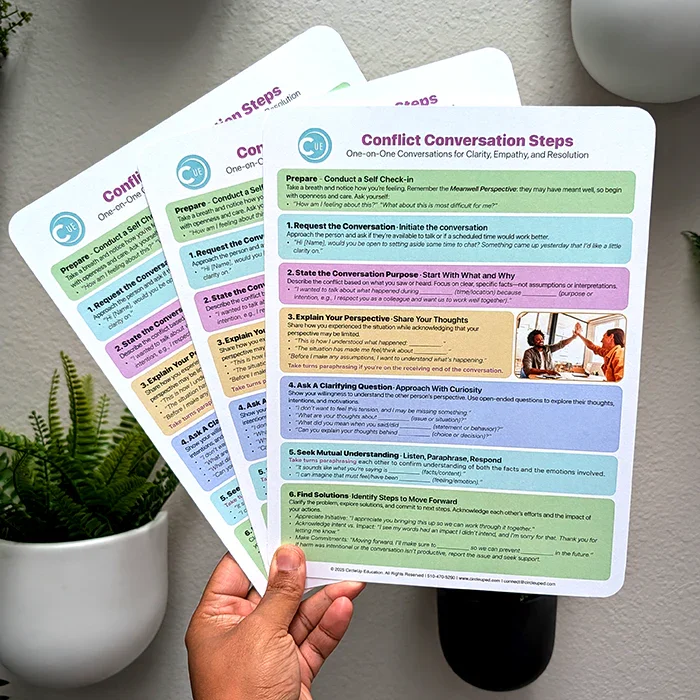
Conflict Conversation Cards
The Feeling Wheel

A hand holding three copies of "The Feeling Wheel," a circular chart with sections labeled with different emotions and feelings, titled "A Tool for Understanding, Naming, and Sharing Emotions." In the background, there are two potted plants and a white wall.

Bring Restorative Conversations™ To Your Team

Schedule Your FREE 30-minute assessment meeting today!

Let’s Connect Today!

Hours
Monday–Friday
7am–7pm Pacific Standard Time

Location
Oakland, California | & Your City!