
CircleUp® Restorative Justice Training
Restorative Justice Trainings, Certificates & Practitioner Pathways
Build restorative justice knowledge, facilitation skills, and real-world practice through CircleUp® live online, in-person, self-paced, and organizational training. Explore restorative conversations, relationship circles, conflict circles, foundational learning, implementation, practitioner certification, and advanced practicum pathways.
- Live Online + In Person
- Flexible Self-Paced Learning
- Professional Practitioner Certifications
- Organizations SCORM + Private Training


Start Here
What are you looking for today?
You do not need to understand every CircleUp® course before you begin. Choose the path that most closely matches what you need right now.
Explore All RJ Trainings
Browse CircleUp® training collections for restorative circles, restorative conversations, foundational learning, implementation, and practitioner development.
Browse training collections →Find the Right Training Path
See recommended sequences based on whether you need to facilitate circles now, develop as a practitioner, lead implementation, or work in diversion and justice settings.
Find your pathway →Earn Practitioner Certification
Explore formal CircleUp® practitioner certifications in Relationship Circles, Conflict Circles, Restorative Conversations, and the Advanced Practicum.
Explore certification pathways →I’m Ready to Register
Skip directly to currently available live online and in-person restorative justice trainings and choose the date that works for you.
See upcoming trainings →Restorative Justice Training Collections
Explore CircleUp® Restorative Justice Trainings
CircleUp® restorative justice trainings are organized into distinct collections so you can quickly understand what each group of courses is designed to teach. Explore practice-based circle facilitation, foundational restorative justice learning, non-circle restorative practices, equity-centered skill development, and companion courses.
CircleCraft™ Relationship Circles Collection
Practice-based restorative justice training for people who want to learn how to design, customize, guide, and facilitate preventative and proactive circles. These trainings focus on relationship building, community agreements, shared values, structured dialogue, team building, classroom circles, and strengthening connection before conflict occurs.
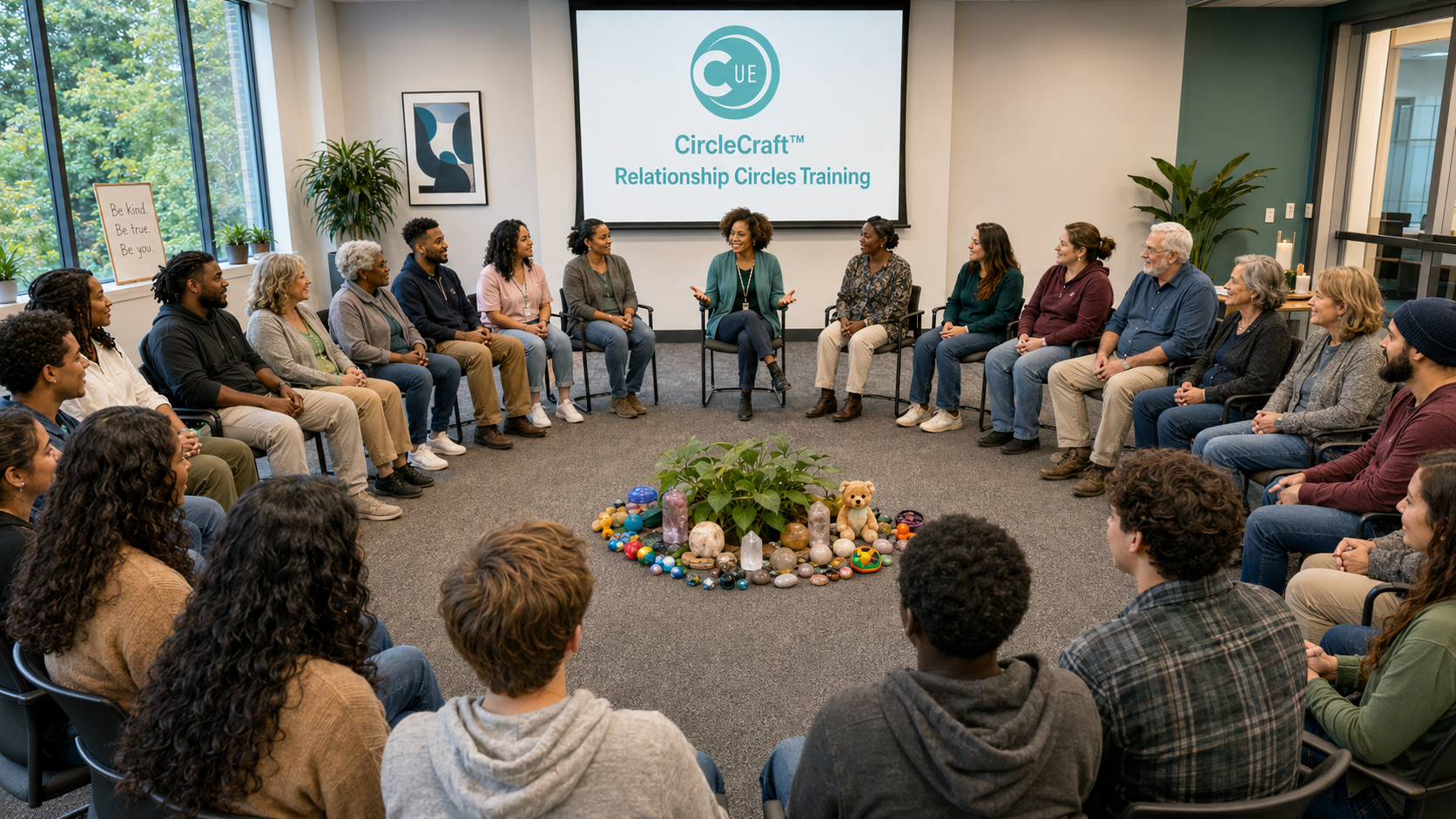
CircleCraft™ Relationship Circles
Learn how to design and facilitate restorative relationship-building circles for community agreements, values exploration, team building, classrooms, workplaces, and community settings.

CircleCraft™ Discussion Circles
Develop structured discussion circles that make space for participation, reflection, shared understanding, and purposeful dialogue while maintaining the core elements of restorative circle practice.
CircleCraft™ Conflict Circles Collection
Responsive restorative justice training for assessing conflict, preparing participants, designing restorative conflict circles, and facilitating conversations that address impact, needs, accountability, understanding, and next steps. Begin with pre-circle assessment and preparation before moving into conflict circle facilitation.
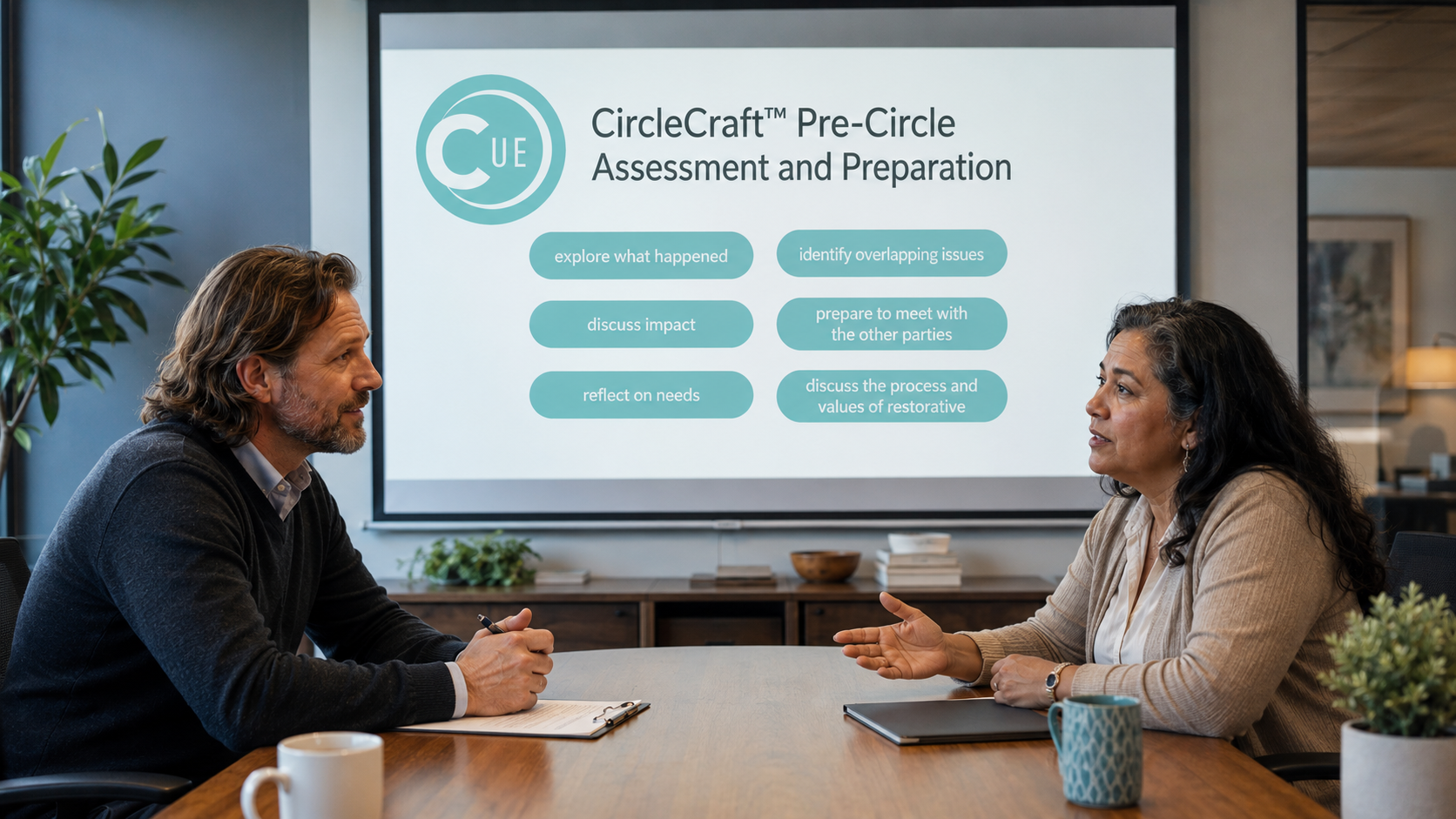
CircleCraft™ Conflict Circles: Pre-Circle Assessment & Preparation
Learn how to assess an incident or conflict, determine readiness, meet with participants one-on-one, identify needs and risks, and gather the information required to thoughtfully prepare for a responsive restorative circle.

CircleCraft™ Conflict Circles
Learn how to use pre-circle information to design and guide restorative conflict circles that support reflection, accountability, understanding, repair, and needs-based next steps for low- to moderate-intensity conflict.

CircleCraft™ Solution Circles
Advance your circle design and facilitation skills for larger, more complex, or more layered restorative situations that require additional preparation, structure, customization, and responsive problem-solving.
CircleRestora® Collection
Foundational restorative justice trainings focused on what restorative justice is, where it comes from, what values ground restorative practice, how restorative and punitive systems differ, and how organizations can thoughtfully implement restorative approaches in schools, workplaces, agencies, and communities.
CircleRestora® Foundations
Build a foundational understanding of restorative justice, including its purpose, core concepts, values, systems, roots, and the practices that distinguish restorative approaches from punitive responses. This training provides a starting point for people who are new to restorative justice or preparing for additional CircleUp® training.

CircleRestora® Restorative Justice Systems
Examine restorative, punitive, discipline, and social justice systems to better understand how justice is defined, what makes an approach restorative, and how underlying values shape practices in schools, workplaces, and communities.

CircleRestora® Restorative Justice Values
Explore the values that ground restorative justice, where those values come from, and how to evaluate whether a practice, response, policy, or process is meaningfully restorative and aligned with restorative principles.

CircleRestora® Restorative Justice Roots
Develop historical and contextual grounding in restorative justice, including the Indigenous roots and traditions that inform contemporary restorative justice practices and the evolution of restorative approaches.
CircleRestora® Restorative Justice Implementation
Learn practical strategies for preparing, planning, and implementing restorative justice across an organization, school, workplace, or community while accounting for culture, capacity, context, and long-term sustainability.
Restorative Justice Essentials Collection
Restorative justice extends beyond circles. This collection develops non-circle restorative practices, communication skills, relationship-building habits, bias awareness, and other capacities that help practitioners work more thoughtfully across identities, situations, and communities.
ChatterMatter®
Build everyday relationship practices through small, repeatable communication and connection habits that strengthen trust, inclusion, belonging, and interpersonal relationships outside of formal circle processes.
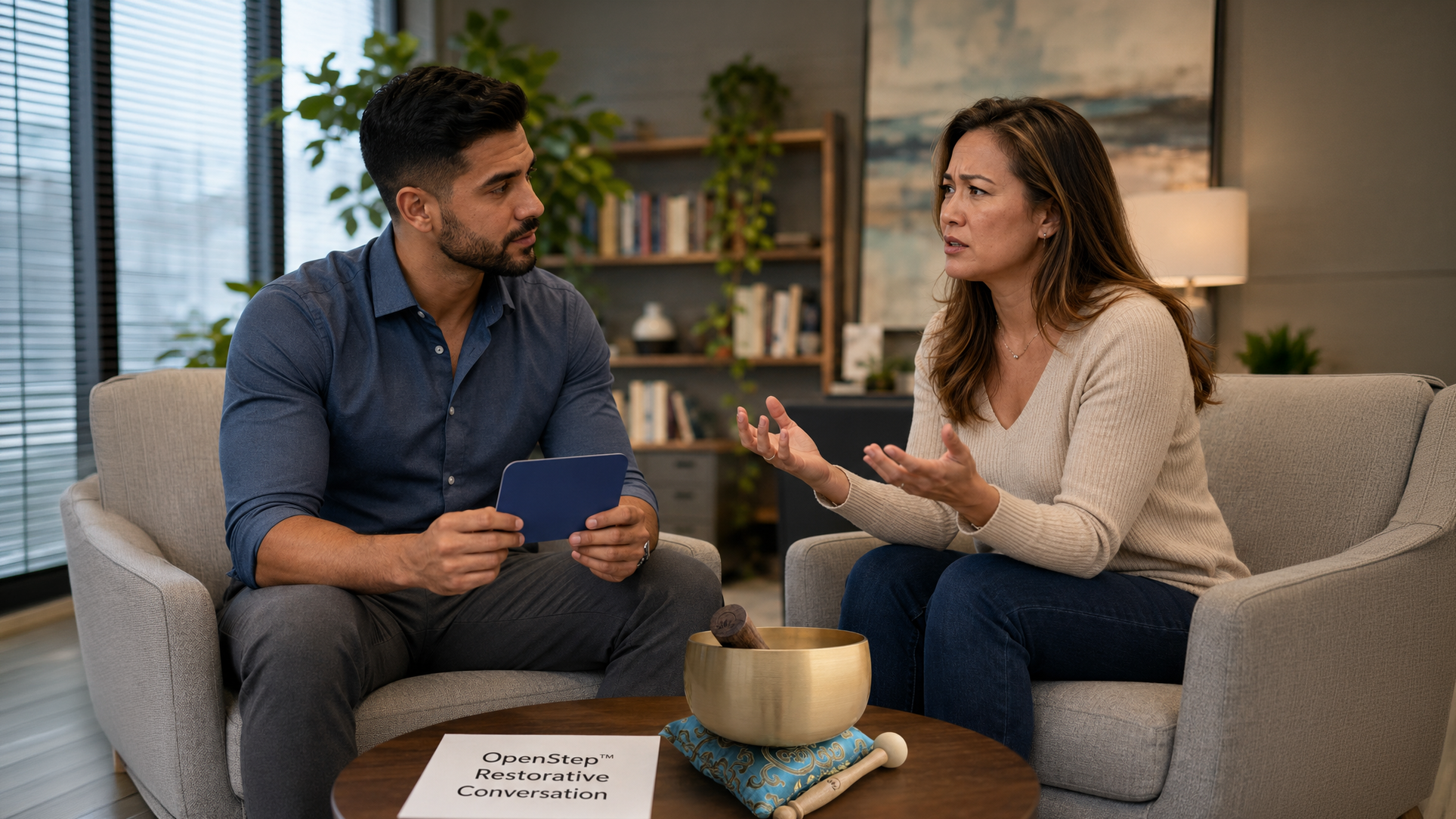
OpenStep™ Restorative Conversations
Learn a repeatable restorative conversation process for listening, understanding impact, exploring needs, reducing tension, and helping people move toward thoughtful, needs-informed next steps.
OpenStep™ Restorative Conversations Practitioner Training
Go deeper into core restorative communication skills through extended instruction, scenarios, structured practice, knowledge checks, and application across different situations and settings.

Implicitly Yours™
Develop greater awareness of explicit and implicit bias, examine how bias can influence decisions and interactions, and build language and practices that support more thoughtful restorative work across diverse communities.

BaseStep™
Learn how to help people move from processing a difficult experience toward needs-based next steps without taking over, giving advice, choosing sides, or creating pressure to accept someone else’s solution.
CircleCraft™ Design Guides Collection
Companion learning designed to help practitioners use CircleCraft™ Design Guides with greater confidence. These courses connect CircleUp® planning tools to practical circle design, facilitation, examples, and real-world application.

CircleCraft™ Relationship Circles Design Guide Companion Course
A free self-paced companion course that walks participants through the CircleCraft™ Relationship Circles Design Guide, introduces foundational restorative concepts, and demonstrates how to use the 10-step process to design complete circles.
Recommended Restorative Justice Training Pathways
Where should I start with restorative justice training?
There is no single learning sequence for every restorative justice practitioner. Start with what your role requires, then build depth over time. These pathways are learning recommendations. Formal CircleUp® Practitioner Certifications have specific required components, assessments, and submissions that are outlined in the certification section below.
Recommended learning pathways and Practitioner Certification pathways are related, but they are not the same thing. Certification requires completion of the designated program requirements.
I need to facilitate restorative circles now.
Best for educators, facilitators, managers, program staff, and community leaders who need practical circle skills quickly and do not need to complete an extensive theory sequence before beginning.
I want a grounded restorative justice practice.
Best for people responsible for restorative justice within a nonprofit, workplace, school, community organization, university, public agency, or other institution.
I lead restorative justice implementation.
Best for school administrators, district leaders, HR leaders, directors, managers, implementation teams, and organizational decision-makers responsible for supporting restorative systems.
I work in diversion, justice, or advanced conflict resolution.
Best for practitioners whose roles involve responsive restorative justice, diversion, complex conflict, facilitated repair, or conflict-resolution processes with significant impact.
Schedule a free 30-minute assessment and we can help identify a starting point for you, your team, or a larger implementation.
Professional Restorative Justice Practitioner Certification
Earn a CircleUp® Restorative Justice Practitioner Certification.
Choose the restorative practice you want to develop and demonstrate. CircleUp® offers professional practitioner certification pathways in Relationship Circles, Conflict Circles, Restorative Conversations, and an Advanced Practicum for deeper, evaluated real-world practice.
These are rigorous, practice-based professional learning programs designed for people who want to develop competency in specific restorative justice practices. Each certification combines restorative justice foundations with applied learning, scenario-based assessment, skills practice, testing, and required work designed to demonstrate that participants can thoughtfully design and apply restorative practices.
Take a course on a specific topic.
Individual CircleUp® courses can be taken independently to develop knowledge or a specific skill. Successful completion earns the certificate identified for that course.
Complete a defined professional pathway.
Practitioner Certification requires the designated live training components, knowledge checks, quizzes or tests, skills practice, scenario-based assessment, and required submissions for that certification pathway.
Relationship Circles
CircleUp® Restorative Justice Practitioner Certification - Relationship Circles
Develop the restorative justice knowledge and circle-design competency needed to create purposeful restorative circles that strengthen relationships, establish shared agreements, explore values, build teams, and guide meaningful group discussion.
Certification develops competency in:
- Restorative justice foundations and basic principles
- Communicating what restorative justice is and how restorative practice differs from punitive approaches
- Community Agreement Circles
- Value Exploration Circles
- Team Building Circles
- Discussion Circles
- Designing and customizing circles for specific groups and goals
- Designing a connected series of circles around a common theme or community goal
Includes live online professional learning, knowledge checks, quizzes or testing, practice, and required circle-design submissions demonstrating the participant’s ability to select, design, adapt, and prepare appropriate circles for different groups and circumstances.
Best for: Educators, managers, facilitators, community leaders, organizational staff, and practitioners who want to use restorative circles proactively to strengthen relationships and community.
Conflict Circles
CircleUp® Restorative Justice Practitioner Certification - Conflict Circles
Build the skills and judgment needed to assess conflict, prepare participants, and design restorative processes that help people address impact, accountability, needs, and next steps.
Certification develops competency in:
- Restorative justice foundations and basic principles
- Explaining restorative justice and responsive restorative processes
- OpenStep™ Restorative Conversations
- Conflict assessment and process selection
- Pre-circle preparation and participant readiness
- CircleCraft™ Assessment Practice
- Mindful Meetings for restorative conferences involving two or, when appropriate, up to three participants
- Restorative communication, impact, accountability, needs, and next steps
Includes the designated conflict-assessment and responsive practice trainings, restorative conversation development, knowledge checks, quizzes or tests, scenario-based decision-making, practice, and submission of conflict-circle designs based on varied situations.
Best for: Practitioners responsible for conflict resolution, responsive restorative justice, student or employee conflict, diversion, accountability processes, or facilitated repair.
Restorative Conversations
CircleUp® Restorative Justice Practitioner Certification - Restorative Conversations
Develop the communication skills and restorative framework needed to help people process difficult experiences, feel heard, identify needs, and move toward thoughtful next steps without requiring a formal circle process.
Certification develops competency in:
- Restorative justice foundations
- OpenStep™ Restorative Conversations
- BaseStep™ needs-based next steps
- Listening and paraphrasing
- Emotional processing
- Open-ended questioning
- Restorative inquiry
- Helping people identify needs and determine thoughtful next steps without rushing to advice or solutions
Includes live professional learning, skills practice, scenario-based assessment, knowledge checks, and rigorous testing designed to evaluate both understanding and application of restorative conversation skills.
Best for: Educators, managers, HR professionals, facilitators, supervisors, community leaders, and practitioners who need restorative communication skills that can be used outside a formal circle.
Advanced Practitioner Practicum
CircleUp® Restorative Justice Practitioner Certification - Advanced Practicum
CircleUp®’s most comprehensive restorative justice practitioner pathway combines advanced study, multiple restorative practices, rigorous competency assessment, and evaluated real-world application.
Advanced study includes:
- Restorative justice history and roots
- Restorative values and principles
- Restorative justice systems
- Relationship Circles
- Conflict Circles
- Pre-circle assessment and preparation
- Solution Circles for larger or more complex conflict
- Restorative Conversations
- Advanced circle design and customization
Unlike pathways based only on coursework and assessment, Advanced Practicum participants apply their learning in actual restorative practice. Required practice is documented and evaluated using CircleUp®’s circle evaluation process, incorporating participant feedback and review of preparation, design, facilitation, and the practitioner’s ability to support intended outcomes.
Best for: Experienced practitioners, program leaders, restorative justice coordinators, facilitators, implementation leaders, and professionals who want to demonstrate not only what they know and can design, but how they apply restorative practices with real people.
These are not attendance-only certificates.
Practitioner certification pathways include designated live online professional learning components.
Participants complete required quizzes, tests, or other assessments connected to the certification outcomes.
Required submissions demonstrate that participants can design and customize restorative processes for specific groups, goals, and circumstances.
Participants demonstrate that they can think through changing circumstances rather than simply memorize the steps of a process.
Certification includes opportunities to practice the restorative skills and processes included in the pathway.
Required certification work is reviewed against the expectations of the specific practitioner pathway.
CircleUp® Training Credentials
How CircleUp® training credentials work.
A Certificate of Completion, Practitioner Certification, and an Advanced Practicum credential do not represent the same level of learning or evidence. CircleUp® uses different credential levels to clearly distinguish successful course completion, assessed practitioner competency, and evaluated real-world practice.
Certificate of Completion
Recognition that a learner successfully completed a designated CircleUp® course or professional learning experience.
- Available for individual courses as identified on the course page.
- Documents successful participation and completion.
- Can accompany a self-paced, live online, or in-person learning experience.
- Does not by itself indicate completion of a full Practitioner Certification pathway.
- Course-specific activities and knowledge checks may still be required.
Practitioner Certification
A professional certification connected to a defined CircleUp® pathway requiring assessed learning, practice, testing, and demonstrated understanding of the specific restorative practice.
- Includes defined certification outcomes.
- Includes required live professional learning components.
- Includes knowledge checks, quizzes, testing, or other formal assessment.
- Includes skills practice and scenario-based application.
- Includes required design or application submissions reviewed as part of certification.
- Documents competency within the scope of the specific certification pathway.
Advanced Practicum Certification
CircleUp®’s highest practice-oriented restorative justice credential, combining comprehensive study, competency assessment, and evaluated application with real participants.
- Includes approximately 40 hours of advanced practitioner learning.
- Includes multiple restorative practices rather than a single specialization.
- Includes advanced design and facilitation requirements.
- Requires documented restorative practice.
- Incorporates feedback from actual participants and/or designated evaluation processes.
- Includes CircleUp® review of preparation, design, facilitation, and applied practice.
Continuing Education
IACET CEUs are separate from your CircleUp® credential.
CircleUp® is an IACET Accredited Provider. Qualifying learning events may award IACET Continuing Education Units in addition to the CircleUp® certificate or certification associated with that training. Course-specific pages and registration information identify whether IACET CEUs are offered, the number of CEUs available, and the requirements for successful completion.
IACET accreditation applies to the continuing education provider and its documented processes. It is not an individual certification of every course or every participant.
Learn about CircleUp® and IACET CEUs →What to Expect from a CircleUp® Training
Learn the practice. Apply the skills. Demonstrate what you know.
CircleUp® restorative justice training is designed to move participants beyond passive attendance. Depending on the course and credential level, participants learn the concepts, see restorative processes modeled, practice skills, use professional tools, check their understanding, and demonstrate what they have learned.
Professional learning designed for real-world restorative practice.
Restorative justice requires more than knowing terminology or memorizing a list of questions. Effective practice depends on understanding why a process works, knowing when and how to use it, recognizing when a situation requires additional preparation, and being able to apply what was learned in real settings.
That is why CircleUp® distinguishes between learning experiences that document course completion and practitioner certification experiences that require demonstrated understanding, application, and, in advanced practicum work, evaluated real-world practice.
Explore Practitioner CertificationDefined Learning Outcomes
Participants know what knowledge, skills, or applications the training is designed to develop.
Active Professional Learning
Training can include discussion, demonstration, reflection, scenario work, design activities, modeling, and guided practice.
Knowledge Checks
Designated courses use knowledge checks throughout the learning experience to help participants confirm understanding as they progress.
Assessment Matched to the Credential
Practitioner and practicum experiences require greater evidence of learning than a course-completion certificate.
Practice You Can Use
CircleUp® trainings emphasize processes, tools, frameworks, and decision-making that participants can bring back to real settings.
Consistent CircleUp® Delivery
CircleUp® maintains its training model internally rather than operating an open consultant or volunteer trainer network for CircleUp®-branded professional learning.

Essential Practitioner Learning
Practice restorative justice with equity, awareness, and fidelity.
Restorative processes do not happen outside of identity, culture, power, access, disability, gender, bias, or lived experience. Technical facilitation skills alone do not prepare a practitioner for every person or situation they may encounter.
CircleUp® therefore recommends complementary professional learning that helps practitioners recognize how their assumptions, beliefs, communication habits, and decision-making can affect participants and restorative processes.
CircleUp® practicum pathways include essential professional learning selected to support more thoughtful practice across diverse people, identities, communities, and situations.
Restorative Justice Training Formats
Choose the way you want to learn.
Take a public training, bring CircleUp® to your organization, learn independently, or deploy selected courses through your own learning management system.
Live Online
Synchronous restorative justice training facilitated live on Zoom by a CircleUp® trainer. Depending on the training, public sessions may include approximately 50–100 participants with facilitated activities, modeling, discussion, and practice.
View live online dates →Live In Person
Instructor-led training facilitated in person at a designated CircleUp® training site or at your organization. Sessions are led by CircleUp® restorative justice practitioners and can include experiential activities and hands-on practice.
View in-person dates →Self-Paced
Complete selected CircleUp® courses on your own schedule through our online learning platform. Self-paced courses may include video, interactive content, practice activities, knowledge checks, assessments, and digital certificates depending on the course.
Explore self-paced courses →SCORM for Your LMS
Larger organizations and school districts can ask about selected CircleUp® courses packaged for implementation through an existing learning management system, supporting broader training rollouts and centralized learning.
Explore SCORM options →Self-paced seats and organization-wide learning are available.
Ask about seat packages, school or district implementations, institutional licensing, and supported SCORM options.
Restorative Justice Training + Practice Tools
Keep restorative practice going after the training ends.
CircleUp® tools are designed to support circle planning, relationship building, restorative conversations, reflection, emotional awareness, and day-to-day facilitation. Individual and bulk purchasing options are available through CircleUp Shop.

CircleCraft™ Relationship Circles Design Guide
A reusable planning system for designing relationship-building and preventative restorative circles.
View tool →CircleCraft™ Conflict Circles Design Guide
A practical reference for planning and structuring restorative circles designed to respond to conflict and harm.
View Design Guide →CirclePedia
A reference resource designed to support circle planning, facilitation, ideas, and continued restorative practice.
Coming Soon
Relationship Building CUE Cards™
Conversation prompts for check-ins, reflection, connection, group engagement, and relationship-building circles.
View cards →
Restorative Conversations™ Card
A portable step-by-step reference for restorative dialogue, processing impact, needs, and thoughtful next steps.
View card →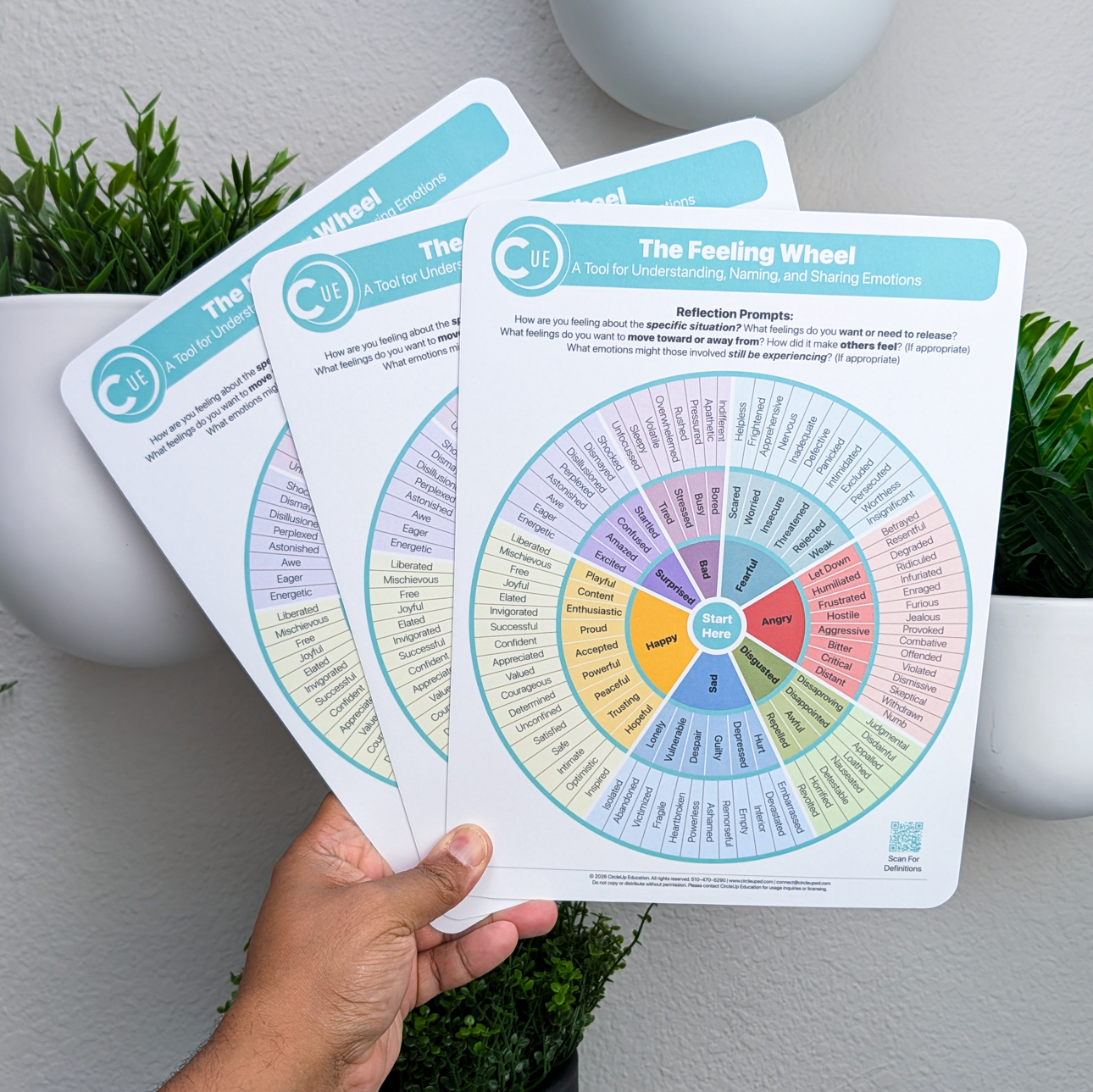
The Feeling Wheel™
Support participants in identifying, naming, and communicating emotions during reflection, conversations, and circles.
View Feeling Wheel →
Emoji Emotions Chart
A visual support for check-ins, emotional expression, reflection, and helping participants communicate how they are feeling.
View Emoji Chart →CircleCraft™ Relationship Circles Framework Planning Posters
Large-format planning supports for collaborative circle design, facilitator training, and team-based planning.
View Planning Posters →Free Live Restorative Justice Training Preview
Considering restorative justice training for your organization? Experience it first.
Our free restorative justice training preview is designed for school administrators, district officials, HR and training leaders, directors, managers, and organizational decision-makers who are considering restorative justice, relationship-building, or conflict resolution training for a larger group.
Experience selected activities, tools, and approaches from CircleUp® restorative justice trainings, then ask questions about course selection, customization, implementation, certifications, training logistics, and organization-wide options.
Learn more about the Restorative Justice Training Preview →Free live preview · Online
Next Restorative Justice Training Preview
Join the next FREE 90-minute sampler session for a focused introduction to CircleUp® restorative justice trainings followed by live Q&A.
Loading next session…
No upcoming sessions right now. Book a private assessment instead.
Register for an upcoming live training
Practical, skill-based restorative justice trainings led live by our team. Every training includes a certificate of completion and qualifying IACET CEUs. Choose a format and date below.
Checking the latest upcoming training dates...
CircleUp® offers upcoming live restorative justice trainings throughout the year. Current dates, times, prices, formats, and registration availability are checked against our live training calendar and refreshed when this page loads.
CircleCraft™ Relationship Circles
Live restorative justice training focused on designing and facilitating proactive relationship-building circles for workplaces, schools, organizations, and communities.
View Relationship Circles Training →CircleCraft™ Conflict Circles
Live responsive restorative justice training covering conflict assessment, participant preparation, circle design, impact, accountability, needs, understanding, and repair.
View Conflict Circles Training →OpenStep™ Restorative Conversations
Live restorative conversation training for listening, understanding impact, identifying needs, reducing tension, and supporting thoughtful next steps.
View Restorative Conversations Training →CircleRestora® Restorative Justice Training
Live restorative justice learning covering foundational concepts, restorative systems, values, implementation, and practical organizational application.
Explore CircleRestora® Trainings →Restorative Justice Essentials
Professional learning in restorative communication, relationship-building, equity, bias awareness, and other restorative justice skills that support effective practice.
Explore RJ Essentials →Restorative Justice Practitioner Certification
Applied professional development and practitioner pathways combining live learning, practice, assessment, and demonstrated restorative justice skills.
Explore Practitioner Certification →Before you enroll: The credential type, assessment requirements, and exact IACET CEU amount, where applicable, are identified for the individual training. IACET CEUs are awarded only for qualifying learning events.
Private + Organization Restorative Justice Training
Bring CircleUp® restorative justice training to your team.
Planning restorative justice training for a school, district, workplace, university, nonprofit, public agency, or community group? Schedule a free 30-minute assessment and we will help you identify the right training, sequence, format, audience, and implementation approach.
Schedule a Restorative Justice Training Assessment
Tell us what you are considering and we will help you identify next steps for training, implementation, group enrollment, self-paced learning, SCORM, or bulk tools.
Questions + Restorative Justice Training Policies
Restorative Justice Training FAQ
Clear answers about CircleUp® training standards, certifications, assessments, registration, refunds, transfers, group purchasing, and organization-wide learning.
Is CircleUp® a credible restorative justice training organization?
CircleUp® is an IACET Accredited Provider. Provider accreditation involves external review of documented continuing education and training processes, including areas such as needs analysis, learning outcomes, instructional content, assessment, learner records, and evaluation.
IACET accreditation applies to the provider and its continuing education processes; it does not mean that IACET individually certifies every CircleUp® course or practitioner. Qualifying learning events are identified with the applicable IACET CEU information and completion requirements.
Learn more about IACET CEUs →What is the difference between an individual training and a Practitioner Certification?
An individual CircleUp® training focuses on a specific topic, process, or professional skill and provides the certificate identified for that learning experience when its completion requirements are met.
A CircleUp® Practitioner Certification is a defined professional pathway with additional requirements. Depending on the certification, these include designated live training components, knowledge checks, quizzes or testing, practice, scenario-based assessment, circle or process design submissions, and CircleUp® review of required work.
Compare Practitioner Certifications →Does CircleUp® offer restorative justice practitioner certification?
Yes. CircleUp® offers defined Restorative Justice Practitioner Certification pathways in Relationship Circles, Conflict Circles, and Restorative Conversations, as well as an Advanced Practicum pathway that combines multiple restorative practices with evaluated real-world application.
Each pathway identifies the specific training, assessment, practice, and submission requirements that must be completed before certification is awarded.
CircleUp® Practitioner Certification is a professional training credential. It is not a government license and does not authorize a practitioner to teach or reproduce CircleUp® proprietary training content.
How does CircleUp® maintain consistency across its trainings?
CircleUp® maintains a centralized training model. CircleUp®-branded live online and live in-person trainings are facilitated by CircleUp® employees rather than an open network of independent consultants, licensed trainers, or volunteers. Self-paced CircleUp® course content is likewise developed and produced through CircleUp®.
This allows the organization to manage curriculum, facilitation standards, course updates, learning materials, assessment requirements, and training quality more consistently across delivery formats.
Do I have to take a test to earn Practitioner Certification?
Practitioner Certification pathways include required knowledge checks, quizzes, tests, assessments, and/or practice experiences connected to the certification requirements.
An individual Certificate of Completion is different. Its requirements depend on the specific course and do not automatically represent completion of a Practitioner Certification pathway.
Advanced Practicum Certification requires additional evidence of applied practice, including designated real-world circle design and facilitation work and evaluation.
What happens if I do not pass a quiz or assessment?
Most CircleUp® course assessments are completed through our online learning environment. Learners are provided with course content and guidance connected to what they are expected to know, and opportunities to review relevant material may be available before retaking an assessment.
Many quizzes and tests use an 80% passing benchmark, but the individual course or certification requirements control. Certain unsuccessful assessments or practicum requirements may require additional training or repeating a course at the participant’s expense. Review the individual training or certification page before enrollment for the requirements that apply.
What is the refund policy for self-paced courses?
A self-paced course may be eligible for a refund before more than 5% of the course has been completed. The opening portion generally gives learners an opportunity to review the course overview, structure, and learning outcomes.
Once more than 5% of the self-paced course has been completed, the course is no longer refundable.
What is the refund or transfer policy for live training?
Live online and live in-person registrations may receive a full refund when cancellation is requested at least 14 calendar days before the training begins.
After the 14-calendar-day refund window, registrations are not refundable; however, participants may request to move to another available date without a transfer penalty.
If you accidentally registered for the wrong course, contact connect@circleuped.com . Depending on the situation, our team can assist with a transfer, an eligible course of similar or lower value, or applicable registration credit for a later training.
Can my organization register multiple people or pay by purchase order?
Yes. If you are registering multiple participants, need help coordinating enrollment, or your institution requires a purchase order, check, or invoice, contact CircleUp® before registration.
Email connect@circleuped.com or schedule a free assessment and our team can help you navigate institutional purchasing.
Can CircleUp® bring restorative justice training directly to our organization?
Yes. CircleUp® works with schools, districts, workplaces, universities, nonprofits, public agencies, and community organizations to provide private restorative justice training.
Training can be delivered live online or in person depending on the program, location, audience, and organizational needs. Begin with a free 30-minute assessment so our team can understand your goals and recommend an appropriate sequence.
Does CircleUp® provide restorative justice training outside California?
Yes. CircleUp® provides training beyond California through live-online programs, private organizational training, and selected in-person engagements. We work with organizations across the United States and can discuss selected international engagements based on location and program requirements.
Are training materials included in the registration price?
Most CircleUp® live online and live in-person training prices include the materials required to participate in the training. Some courses may have exceptions, optional companion tools, or separate materials.
Always review the individual training description before enrollment for the exact materials included and anything you may need to purchase or prepare separately.
Can we put CircleUp® self-paced courses inside our LMS?
Selected CircleUp® courses may be available for larger implementations through seat-based eLearning options or SCORM packages that can be incorporated into a supported organizational learning management system.
Availability varies by course. Contact our team to discuss your LMS, number of learners, implementation scope, reporting needs, and available packages.
Explore SCORM for your LMS →Does CircleUp® use volunteers or independent consultants to facilitate official trainings?
No. CircleUp® does not use volunteers or an open independent consultant network to facilitate official CircleUp®-branded live trainings. CircleUp® live training facilitators are CircleUp® employees.
If you encounter someone representing an independent training as an official CircleUp® training and you would like to verify it, contact connect@circleuped.com or call (510) 470-5290 .
Your Next Step
Build the restorative justice practice your role requires.
Explore the complete training collection, begin a Practitioner Certification pathway, register for an upcoming live course, learn on your own schedule, or talk with CircleUp® about training your school, district, workplace, organization, or community.